

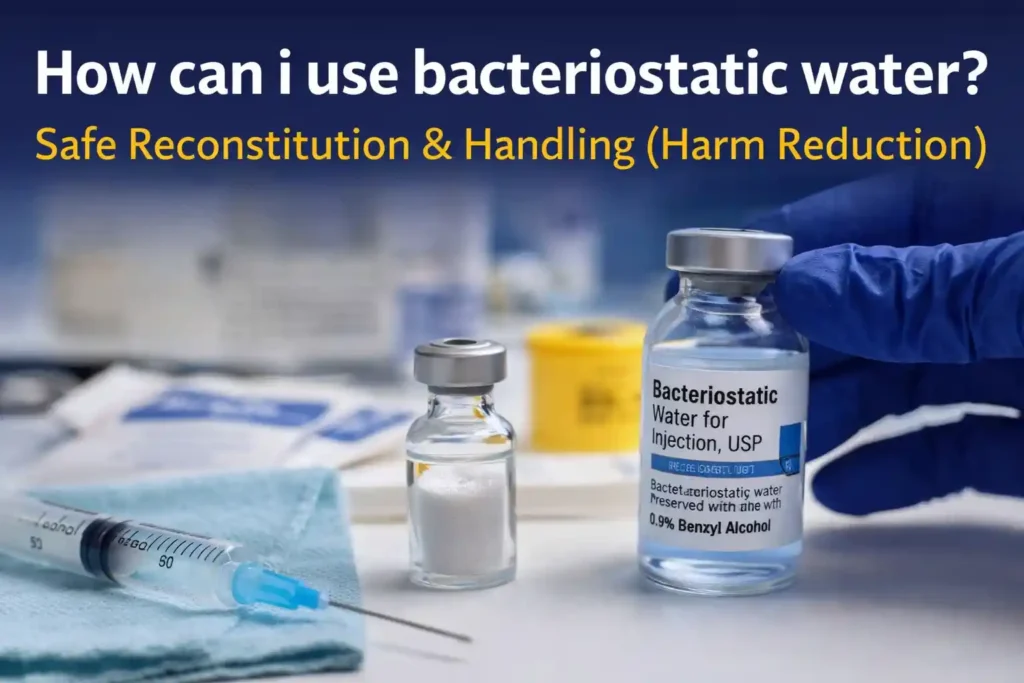
How can i use bacteriostatic water? Safe Reconstitution & Handling (Harm Reduction)
Internal links (replace with your site pages): Peptide Reconstitution 101 (Math + Technique), Does Bacteriostatic Water Go Bad? 28-Day Rule vs Reality, Sterile Injection Technique at Home.
External safety references: CDC Injection Safety, FDA: Buying medicines safely online, USP Compounding (overview).
Direct Answer
How can i use bacteriostatic water? You use it as a sterile reconstitution solution to dissolve certain lyophilized (freeze-dried) medications or peptides, and as a multi-dose diluent when repeated withdrawals are allowed. The safe method is: swab stoppers, use a brand-new sterile needle/syringe each entry, inject bacteriostatic water slowly down the vial wall, swirl (don’t shake), label the vial, refrigerate if appropriate, and discard on schedule (often 28 days after first puncture unless labeling says otherwise).
Key takeaway: Bacteriostatic water doesn’t make sloppy technique “safe.” It simply gives you a small preservative buffer in a multi-dose workflow.
If you’re asking “how can i use bacteriostatic water,” you’re really asking two questions: (1) “How do I reconstitute correctly so my solution stays stable?” and (2) “How do I keep the vial clean enough that I’m not injecting contamination?”
This guide is written for citizen researchers: smart people who want practical, real-world harm reduction—without pretending home technique is identical to a clinical clean room.
How can i use bacteriostatic water safely (the big picture)
Bacteriostatic water is sterile water with a preservative (commonly benzyl alcohol) intended for multi-dose use. “Bacteriostatic” means it inhibits bacterial growth—it does not mean it sterilizes dirty technique or prevents contamination forever.
How can i use bacteriostatic water safely? Think in systems:
- Source control: buy labeled “for injection” products from reputable sellers.
- Technique control: every puncture is a contamination opportunity—reduce opportunities and keep them clean.
- Storage control: protect the solution from heat/light and follow “after opening” discard rules.
Key takeaway: Your results are less about “the water” and more about whether your process stays sterile enough for repeated vial access.
What bacteriostatic water is (and what it is not)
People often treat bacteriostatic water like a magical sterile ingredient. It’s not magical. It’s simply:
- Sterile water
- plus a preservative that slows bacterial growth in a multi-dose vial
What it is not:
- Not a substitute for sterile technique
- Not automatically compatible with every compound
- Not something you should keep using indefinitely just because it “looks clear”
Key takeaway: When you ask “how can i use bacteriostatic water,” the honest answer starts with: use it only in workflows where preservative-containing diluent is appropriate.
Before you use it: confirm your compound allows bacteriostatic water
This is the part many people skip—and it’s where “simple reconstitution” becomes “why does this burn?”
Check the product instructions (or your pharmacist/clinician)
Some compounds are fine with bacteriostatic water. Some prefer sterile water. Some specify saline. Some explicitly avoid certain preservatives.
Harm reduction: if the instructions say sterile water only or saline only, don’t freestyle unless you’ve verified compatibility with a qualified professional.
When bacteriostatic water is commonly chosen
- You need repeated withdrawals over days/weeks
- You want a multi-dose workflow with a preservative buffer
- The compound’s instructions allow it
Key takeaway: The best answer to “how can i use bacteriostatic water” includes “only when it fits the compound’s rules.”
Supplies you actually need (and why each one matters)
If you want to use bacteriostatic water without turning your vial into a contamination experiment, your supply list matters.
Minimum setup
- Bacteriostatic water vial (sealed, labeled, intact)
- Lyophilized vial (your peptide/medication powder)
- Sterile syringes (appropriate volume)
- Sterile needles (brand-new each time you enter a vial)
- Alcohol swabs (for vial stoppers and skin prep if injecting)
- Sharps container (or an approved puncture-resistant alternative)
- Labels/marker (opened date, discard date, concentration)
Nice-to-have upgrades
- Vial organizer (reduces drops/handling errors)
- Clean tray or dedicated workspace mat (reduces surface contact)
- Spare needles (so you never “stretch” a used one)
Key takeaway: The most common reason people fail at “how can i use bacteriostatic water safely” is not a chemistry issue—it’s a workflow issue.
Workspace hygiene: the part nobody wants to do (but everyone needs)
You don’t need a surgical suite. You do need to stop doing sterile tasks on a cluttered counter next to a sink.
Quick setup routine
- Wash hands (soap + water; dry with a clean towel)
- Clear a dedicated surface
- Avoid fans blowing directly over your workspace
- Keep pets out of the room (seriously)
- Open supplies only when you’re ready to use them
Key takeaway: “How can i use bacteriostatic water safely” begins before the needle touches anything.
How can i use bacteriostatic water for reconstitution (step-by-step)
This is the core method most people are looking for when they ask how can i use bacteriostatic water to reconstitute a lyophilized vial.
Step 1: Inspect both vials
- Check labels and expiration dates
- Check the glass for cracks/chips
- Confirm the powder looks normal (dry, not melted/oddly clumped unless expected)
Step 2: Swab both stoppers (every time)
Use separate alcohol swabs on each stopper. Scrub the rubber top. Then let it fully dry. Wet alcohol isn’t sterile magic—it’s just wet.
Step 3: Draw air into the syringe first
Draw in an amount of air roughly equal to the amount of bacteriostatic water you plan to withdraw. This helps equalize pressure and makes the draw smoother.
Step 4: Withdraw bacteriostatic water
- Use a brand-new sterile needle/syringe
- Insert into the bacteriostatic water vial
- Inject the air into the vial (helps prevent vacuum lock)
- Invert vial and withdraw the desired amount
- Tap out bubbles and re-measure accurately
Harm reduction detail: If your needle touches anything non-sterile (counter, fingers, vial rim), replace it. Don’t negotiate with contamination.
Step 5: Inject bacteriostatic water into the powder vial slowly
Aim the stream down the inside wall of the vial, not directly onto the powder like a pressure washer. Going slow reduces foaming and reduces the chance of damaging delicate molecules.
Step 6: Dissolve gently (swirl, don’t shake)
Swirl the vial. Roll it between your fingers. Let it sit and re-swirl. Avoid vigorous shaking unless your compound’s instructions specifically allow it.
Key takeaway: If you want the best answer to “how can i use bacteriostatic water,” it’s this: slow and clean beats fast and sloppy.
Reconstitution math without the headache (so you don’t guess doses)
Most people don’t get hurt because they can’t do algebra. They get hurt because they “eyeball it” and then change volumes every time.
Basic concentration formula
Concentration = total amount of compound ÷ total volume of liquid
Example (generic): If you have 10 mg powder and add 2 mL bacteriostatic water, then:
- 10 mg ÷ 2 mL = 5 mg per mL
Harm reduction rule: Write the concentration on the vial. Future-you will not remember.
Key takeaway: “How can i use bacteriostatic water safely” includes “label your concentration so you stop making dosing mistakes.”
Labeling: the boring habit that prevents 80% of chaos
Labeling is not optional if you want a consistent, low-risk workflow.
What to write on the reconstituted vial
- Date reconstituted
- Discard date (follow label guidance; many multi-dose practices use ~28 days after first puncture unless otherwise specified)
- Concentration (e.g., “X mg/mL”)
- Storage (“fridge” if applicable)
Key takeaway: Labeling is part of the answer to “how can i use bacteriostatic water” because it prevents accidental misuse and “mystery vials.”
How can i use bacteriostatic water in a multi-dose routine (without contaminating it)
Once the vial is open, your main enemy is repeated access.
The three rules that matter most
- Swab the stopper every single time (and let it dry)
- New sterile needle and syringe every single entry
- Minimize punctures (plan withdrawals; don’t “double-check” by re-entering)
Why “used needle just for drawing” is a contamination trap
The moment a needle touches skin or air or any surface, it’s no longer sterile. Re-using it to enter a vial turns the vial into the “collection point” for everything that needle picked up.
Key takeaway: If you’re serious about “how can i use bacteriostatic water safely,” commit to never re-entering vials with used needles.
Storage: fridge vs room temp (and what most people get wrong)
Storage decisions should be based on the compound you reconstituted and the product labeling, not on forum vibes.
Bacteriostatic water (unopened)
Store as directed on the label. Keep it away from direct sunlight and heat.
Reconstituted peptide/medication (opened)
Many reconstituted compounds are stored refrigerated to help stability, but not all. Some are sensitive to freezing or repeated temperature cycling.
Harm reduction: if refrigerating, keep the vial in a box or dark container. Avoid constant door-swing temperature changes. Store upright.
Can you freeze bacteriostatic water?
Generally: no. Freezing can stress glass, compromise seals, and create concentration changes during freeze/thaw. Even if the vial survives, you added risk without gaining reliable sterility.
Key takeaway: A clean workflow beats “storage hacks” when you’re answering “how can i use bacteriostatic water safely.”
The 28-day rule: what it means for bacteriostatic water use
Many multi-dose vial policies use a conservative “discard after ~28 days from first puncture” approach unless manufacturer labeling says otherwise. In practice, the risk is cumulative: more punctures and poorer technique = higher contamination risk sooner.
What’s actually happening over time
- Each puncture adds contamination opportunity
- The preservative buffer can become less reliable with repeated challenges
- The stopper can degrade or “core” (tiny rubber particles) with heavy puncture history
Harm reduction: Don’t treat day 29 like a cliff, but don’t treat it like nothing changed either. If you don’t know your first puncture date, treat the vial as expired.
Key takeaway: “How can i use bacteriostatic water” responsibly includes dating and discard discipline.
Visual safety check: what “bad” solution looks like
Clear solutions can still be contaminated, but visible changes are a hard stop.
- Cloudiness or haze
- Floaters, particles, strands
- Discoloration (yellowing, browning, any tint)
- Damaged stopper or cracked vial
Key takeaway: If you see anything off, discard. The cost of replacement is lower than the cost of complications.
Injection-site pain: what’s normal vs what’s a warning
Some injections have baseline discomfort. The concern is when pain changes character or intensity.
Common (but not “good”) causes of extra pain
- Injecting too fast
- Solution too cold (let it warm slightly in your hands)
- Irritation from technique (dull needle, repeated pokes)
- Wrong diluent for the compound
Red flags (stop and reassess)
- Increasing redness, warmth, swelling
- Hard lump that worsens
- Fever, chills, systemic symptoms
- Severe pain out of proportion
Harm reduction: if you suspect infection, don’t “wait it out” with more injections in the same area. Seek medical help.
Common mistakes that make bacteriostatic water “unsafe” fast
If you want the real answer to “how can i use bacteriostatic water,” learn what shortens its safe life.
- Not swabbing the stopper every time
- Not letting alcohol dry
- Re-using needles or syringes
- Touching the needle or laying it down
- High puncture count from frequent micro-withdrawals
- Storing in heat/light (countertops, windowsills, cars)
- No labels (unknown dates = unknown risk)
Key takeaway: Most “mystery problems” are predictable process failures.
How can i use bacteriostatic water if I only have sterile water?
Important distinction: sterile water and bacteriostatic water are not interchangeable in multi-dose behavior.
Sterile water basics
Sterile water typically contains no preservative. That means it’s generally intended for single-use behavior—use what you need and discard the rest rather than repeatedly puncturing it over days.
Harm reduction: If you must use sterile water for reconstitution in a multi-dose plan, you’re choosing a higher-contamination-risk setup unless you can ensure single-use handling. In many cases, the safer move is to obtain the correct diluent rather than forcing the workflow.
Key takeaway: “How can i use bacteriostatic water” is partly about not substituting the wrong diluent for convenience.
FAQ: How can i use bacteriostatic water without mistakes?
How can i use bacteriostatic water for peptides?
Use it as the reconstitution solution if the peptide allows it: swab both stoppers, withdraw the desired volume with a new sterile needle/syringe, inject slowly down the vial wall, swirl gently, then label and store appropriately.
How can i use bacteriostatic water and avoid contamination?
Swab every time, use a new sterile needle and syringe for every entry, minimize punctures, store in a dark stable place, and discard on schedule.
How can i use bacteriostatic water if the vial is older but looks clear?
Clear doesn’t guarantee sterile. If you’re beyond recommended in-use timelines or you don’t know the first puncture date, the safest choice is to discard and replace.
How can i use bacteriostatic water if I refrigerate it?
Refrigeration can slow bacterial growth if contamination occurs, but it does not sterilize. Still follow strict sterile technique and discard rules.
How can i use bacteriostatic water for multiple vials?
Keep the bacteriostatic water vial itself clean: every entry is a risk. If you’re reconstituting multiple vials often, consider smaller bacteriostatic vials to reduce how long one vial stays in rotation.
How can i use bacteriostatic water responsibly (summary)
- How can i use bacteriostatic water? As a sterile reconstitution solution for compatible compounds and as a multi-dose diluent when repeated withdrawals are allowed.
- Technique: swab stoppers, let dry, new sterile needle/syringe every entry, inject slowly, swirl don’t shake.
- Label: reconstitution date, discard date, concentration.
- Store: protect from heat/light; refrigerate if appropriate for your compound; don’t freeze.
- Discard: follow label guidance; treat unknown dates or visible changes as discard conditions.
Final takeaway: The safest answer to “how can i use bacteriostatic water” is not a single trick—it’s a repeatable sterile workflow you can actually stick to.