

Single-Dose vs Multi-Dose Vials: Sterile Water Use Explained (Risk, Dating, Storage, and Best Practices) 2026
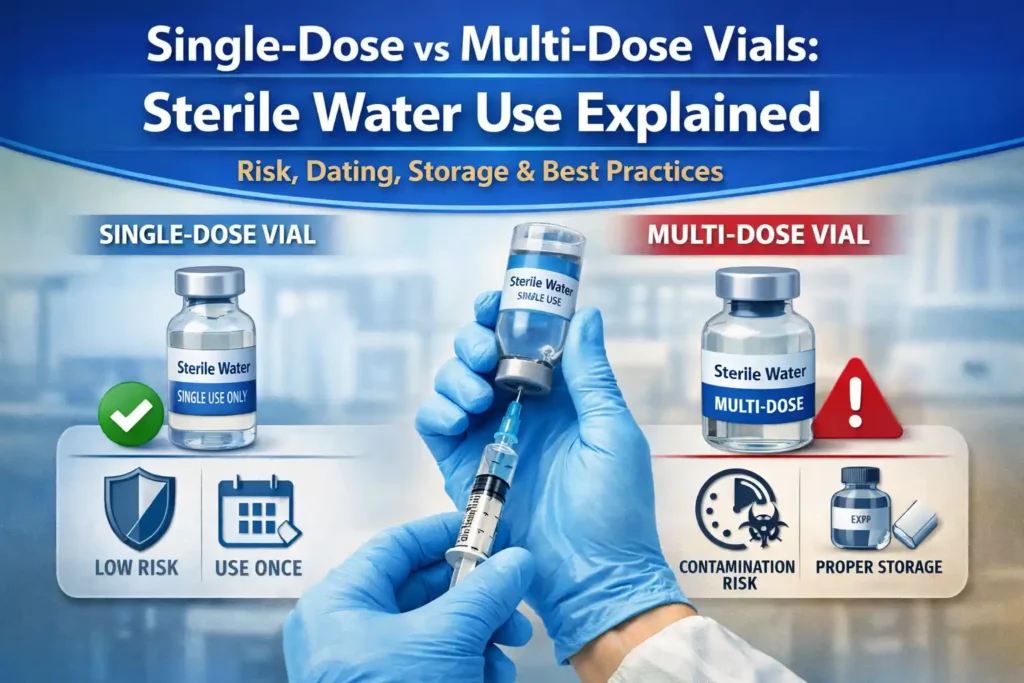
Single-Dose vs Multi-Dose Vials: Sterile Water Use Explained Single-dose vs multi-dose vials sterile water use explained is ultimately a question about what happens after the first puncture. Many people assume that if a solution is “sterile,” it stays safe until it looks cloudy or reaches an expiration date. That assumption is the root of most […]
Common Reconstitution Mistakes That Reduce Drug Potency (Foaming, Heat, Light, Diluent Errors, and Handling Fixes) 2026
Common Reconstitution Mistakes That Reduce Drug Potency Common reconstitution mistakes that reduce drug potency are rarely dramatic. Most potency loss happens quietly—without a visible color change, without cloudiness, and without any immediate clue that the preparation is no longer performing as intended. A vial can look “perfect” while the active compound has partially degraded, aggregated, […]
Why Benzyl Alcohol Matters in Bacteriostatic Water (What It Does, What It Doesn’t, Safety Limits, and Best Practices) 2026
Why Benzyl Alcohol Matters in Bacteriostatic Water Why benzyl alcohol matters in bacteriostatic water is ultimately a question about risk management. People often treat bacteriostatic water as “sterile water you can reuse,” but that casual description hides the real reason the product exists: to reduce bacterial growth risk after repeated vial access. Benzyl alcohol is […]
Shelf Life & Storage: How Long Does Reconstituted Medication Really Last? (Stability, Beyond-Use Dating, Risk Factors, and Discard Rules) 2026
Shelf Life & Storage: How Long Does Reconstituted Medication Really Last? How long does reconstituted medication really last is one of the most searched questions in peptide handling, injectable protocols, pharmacy compounding workflows, and everyday clinical medication prep. It’s also one of the most misunderstood—because people want a single universal number, while shelf life after […]
Reconstitution Best Practices for Peptides and Lyophilized Medications (Aseptic Technique, Diluent Choice, Stability, and Common Errors)
Reconstitution Best Practices for Peptides and Lyophilized Medications Reconstitution best practices for peptides and lyophilized medications are not “nice-to-have” habits—they’re the difference between a predictable, stable preparation and a compromised solution with unknown potency and contamination risk. Lyophilized (freeze-dried) products are engineered to preserve stability during storage, but once reconstituted they become a live system: […]
Bacteriostatic Water vs Sterile Water: When Each Should (and Shouldn’t) Be Used (Safety, Use Cases, and Risk Management)
Bacteriostatic Water vs Sterile Water: When Each Should (and Shouldn’t) Be Used Bacteriostatic water vs sterile water is not a “two products, same outcome” situation. It is a decision about risk systems. Both are sterile when unopened, but they are designed for different handling realities after puncture, different patient populations, and different safety constraints. Treating […]
Reconstitution Solution Guidelines (2026) for Hospitals and Clinics: Diluents, Aseptic Workflow, Labeling, Storage & Shortage SOPs
Reconstitution Solution Guidelines for Hospitals and Clinics Reconstitution solution guidelines exist for a simple reason: the right diluent and the right workflow prevent the most common and most expensive medication preparation failures—wrong diluent selection, contamination, wrong concentration, and unknown-history use. In hospitals and clinics, reconstitution feels routine until it suddenly isn’t: a shortage forces unfamiliar […]
Common Mistakes When Reconstituting Injectable Drugs 2026
Common Mistakes When Reconstituting Injectable Drugs common mistakes when reconstituting injectable drugs rarely happen because people want to do things unsafely. They happen because reconstitution feels routine, clinics are busy, supplies look similar, and small shortcuts stack up. A “little” shortcut—like not letting alcohol dry—becomes a big risk when repeated across dozens of punctures a […]
How Long Does Reconstituted Medication Last? (2026) Storage and Stability Explained + Clinic Checklist
How Long Does Reconstituted Medication Last? Storage and Stability Explained how long does reconstituted medication last is one of the most important questions in any clinic that mixes, reconstitutes, or prepares injectable medications. Reconstitution turns a dry product into a usable solution or suspension, but it also starts a clock. That clock is not just […]
Is Bacteriostatic Water Single-Dose or Multi-Dose? (2026) Labeling, Safety Rules, Storage & Discard-By Guide
Is Bacteriostatic Water Single-Dose or Multi-Dose? Is bacteriostatic water single-dose or multi-dose? This is one of the most common “simple-sounding” questions that can turn into real clinic risk if the answer becomes a shortcut. People hear “bacteriostatic” and assume it means “safe to use forever” or “safe for multiple patients.” Others see “sterile water” and […]